Why Full Range of Motion Matters
Andrew Martz • 22. Februar 2026
Half reps are hurting you!
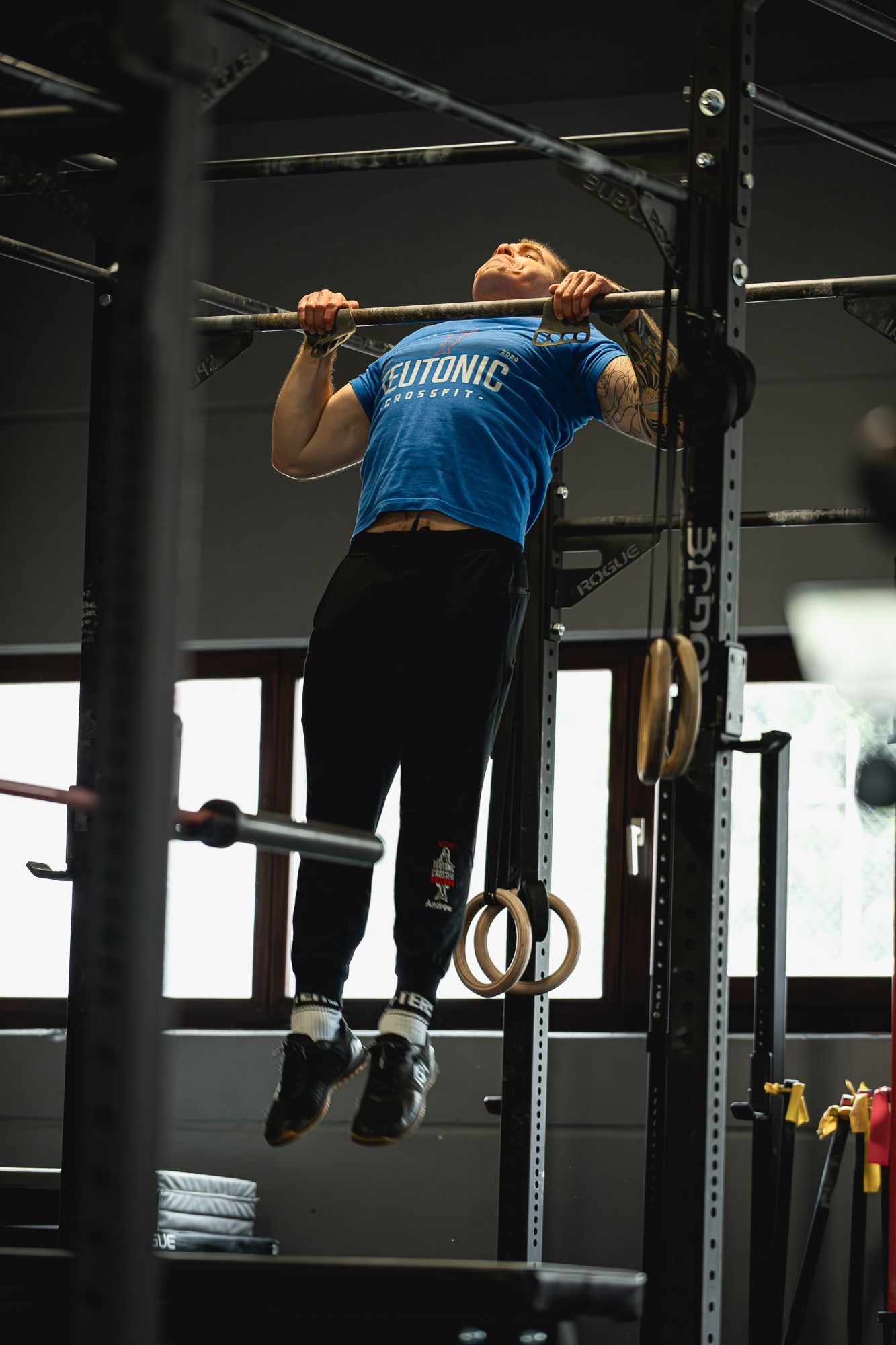
At Teutonic CrossFit, we talk a lot about “full range of motion” (ROM). Hips below knees. Chin over bar. Full lockout overhead.
And no, it’s not because we enjoy saying, “No rep.”
It’s because full ROM isn’t just a standard — it’s a stimulus. And the science behind it is pretty compelling.
Let’s break down what happens when you train through full ranges… and what happens when you don’t.
---
Full ROM Builds Stronger, More Stable Joints
When you move a joint through its complete range under control, several things happen.
Improved Joint Stability
Strengthening through full ROM improves neuromuscular control across the entire arc of motion. That means your brain gets better at coordinating muscles at both shortened and lengthened positions.
Research has consistently shown that resistance training through a full ROM improves strength across a broader portion of the strength curve compared to partial ROM training (Pinto et al., 2012; Bloomquist et al., 2013).
Pinto et al., 2012 found greater strength gains with full ROM bench press compared to partial ROM.
Bloomquist et al., 2013 showed deeper squats led to greater improvements in strength and hypertrophy than shallow squats.
When you skip end ranges, you essentially create “strength dead zones.” Your nervous system becomes strong where you train — and weak where you don’t.
And guess where injuries often occur?
At end range.
---
Muscle Length, Mobility, and Adaptation
Muscles aren’t just rubber bands. They adapt structurally to the positions you repeatedly train.
Training at Longer Muscle Lengths
Emerging research suggests that resistance training at longer muscle lengths may produce superior hypertrophy compared to training at shorter lengths.
Maeo et al., 2021 showed greater hypertrophy when muscles were trained at long lengths.
Pedrosa et al., 2022 (systematic review) supported the idea that lengthened-position training may enhance muscle growth.
What Happens at the Cellular Level?
When you load a muscle in a lengthened position:
- You increase mechanical tension, the primary driver of hypertrophy.
- You stimulate signaling pathways like mTOR, responsible for muscle protein synthesis.
- There is evidence suggesting the addition of sarcomeres in series (longitudinal muscle adaptation), meaning muscles can increase functional length over time.
The result?
Greater cross-sectional area of muscle fibers (hypertrophy), and strength gains that transfer across more of the range of motion.
In simple terms:
Train long → get strong everywhere.
---
More Range Equals More Strength
Full ROM typically requires:
- Greater total work
- More muscle activation
- Higher time under tension
- Greater stretch-mediated mechanical stress
Bloomquist et al. (2013) demonstrated that deeper squats produced superior hypertrophy of the quadriceps compared to shallow squats — even when total training volume was controlled.
Translation: half squats build half adaptations.
---
The Flip Side: What Happens When You Avoid Full Range?
Now let’s talk about the dark side of partial reps.
Muscles Adapt to Shortened Positions
If you consistently train (or live) in shortened ranges:
- Hip flexors adaptively shorten from prolonged sitting.
- Hamstrings lose excursion.
- Thoracic spine stiffens.
- Shoulders drift forward.
Muscle tissue remodels based on chronic positioning. If you spend most of your day seated and then perform quarter squats in the gym, you are reinforcing the same shortened pattern.
Your body assumes:
“Oh, this is our usable range now.”
And it adapts accordingly.
---
Example: The Shallow Squat Cascade
Let’s build this out biomechanically.
Step 1: Limited Squat Depth
If you avoid depth:
- You underload glutes in their lengthened position.
- You don’t challenge hip flexion fully.
- You don’t develop strength at end-range hip flexion.
Step 2: Adaptive Tightness
If hip flexors are chronically shortened (hello desk life) and you never train deep hip flexion under load:
- You reinforce anterior pelvic tilt.
- Glutes become underactive in lengthened positions.
- Lumbar extensors compensate.
Step 3: Lumbar Spine Pays the Bill
Anterior pelvic tilt increases lumbar lordosis.
Increased lordosis increases compressive stress on posterior spinal elements.
Over time, this may contribute to:
- Low back discomfort
- Facet irritation
- Disc stress (depending on load and other factors)
Now, are shallow squats the sole cause of back pain?
Of course not.
But training exclusively in shortened ranges can absolutely contribute to movement dysfunction over time.
---
Posture: You Become What You Practice
Muscles that are consistently held in shortened positions can reduce extensibility over time. Research in muscle architecture shows that immobilization in shortened positions leads to loss of sarcomeres in series (Williams & Goldspink, 1978).
In contrast, immobilization in lengthened positions increases sarcomere number.
Your body literally remodels at the microscopic level based on position.
So if:
- You sit 8 hours
- Drive 1 hour
- Scroll 2 hours
- And train in partial ranges
You are reinforcing flexion dominance all day long.
And then we wonder why shoulders round forward and backs ache.
---
Does This Mean Partial ROM Is Useless?
No.
Partial ROM can be useful:
- Overload training
- Rehab phases
- Addressing sticking points
- Sport-specific angles
But as a primary training strategy?
It leaves strength on the table — and sometimes invites imbalance.
---
The Teutonic Standard
At Teutonic CrossFit, when we ask for:
- Hips below parallel
- Full lockout overhead
- Chest to bar
- Full extension on pulls
It’s not about being strict for the sake of being strict.
It’s because:
- Full ROM builds joint integrity
- Lengthened-position loading enhances hypertrophy
- Strength gains transfer better
- Posture improves
- And your 77-year-old self will thank you
Yes, even future-you with creaky knees.
---
The Takeaway
Train through the largest controllable range you can own with good mechanics.
Full range of motion:
- Builds strength across the entire joint arc
- Stimulates superior hypertrophy adaptations
- Improves mobility under load
- Enhances long-term joint resilience
Half reps have their place.
But if you want long-term performance, durability, and a body that doesn’t feel like a folding lawn chair when you hit 50…
Own the full range.
---
References
Bloomquist, K. et al. (2013). Effect of range of motion in heavy load squatting on muscle and tendon adaptations. European Journal of Applied Physiology.
Pinto, R. S. et al. (2012). Effect of range of motion on muscle strength and thickness. Journal of Strength and Conditioning Research.
Maeo, S. et al. (2021). Greater hypertrophy induced by lengthened position resistance training. Scandinavian Journal of Medicine & Science in Sports.
Pedrosa, G. F. et al. (2022). Resistance training at long muscle lengths and muscle hypertrophy: A systematic review. Sports Medicine.
Williams, P. E., & Goldspink, G. (1978). Changes in sarcomere length and number in immobilized muscle. Journal of Anatomy.